Updated on Nov. 20, 2026 at 12:48 a.m. ET
The leaders of the United States, China and Russia concluded their first-ever trilateral summit in Shenzhen on Thursday, but their meeting was more about “optics over substance,” experts told Radio Free Asia.
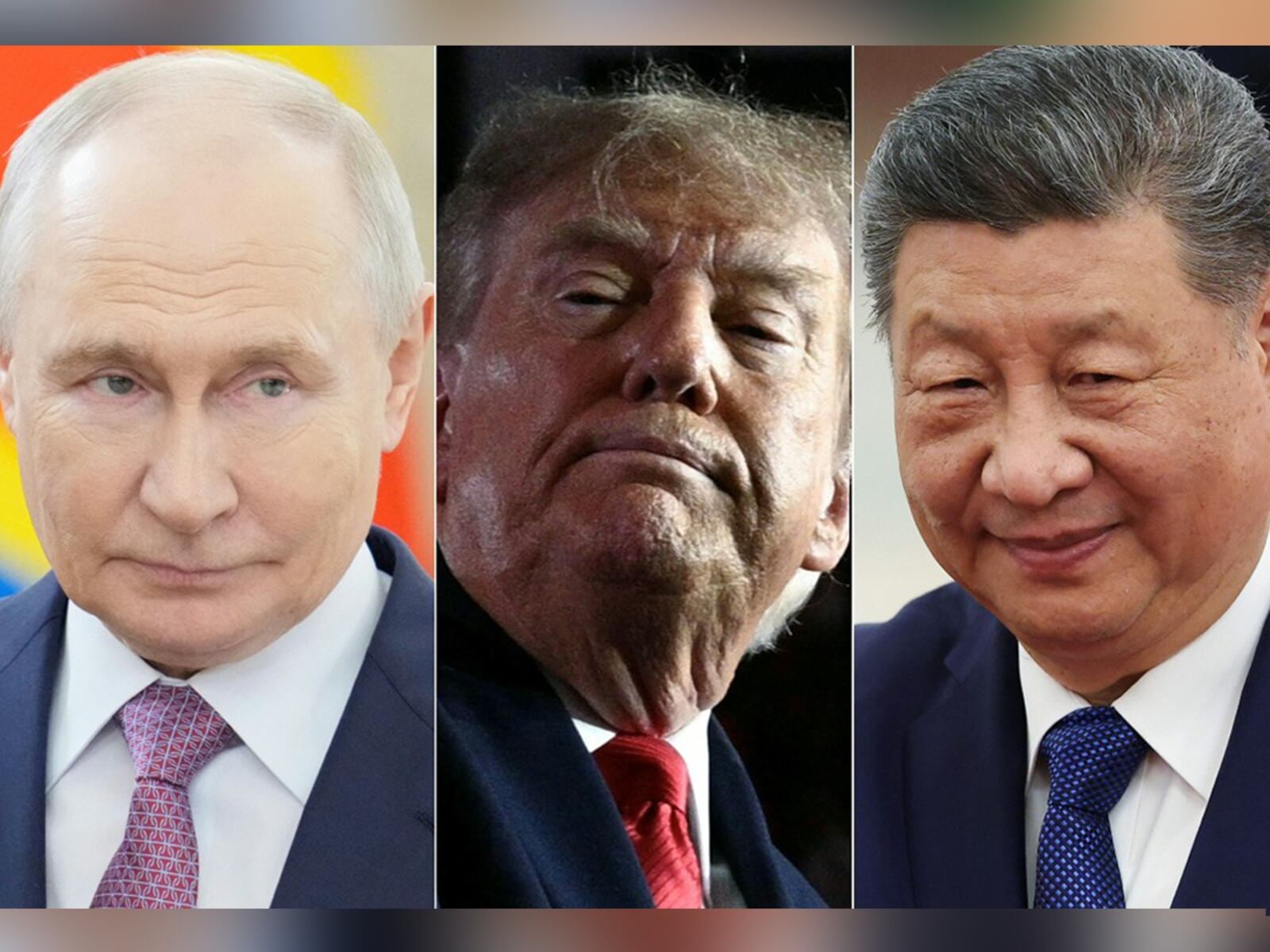
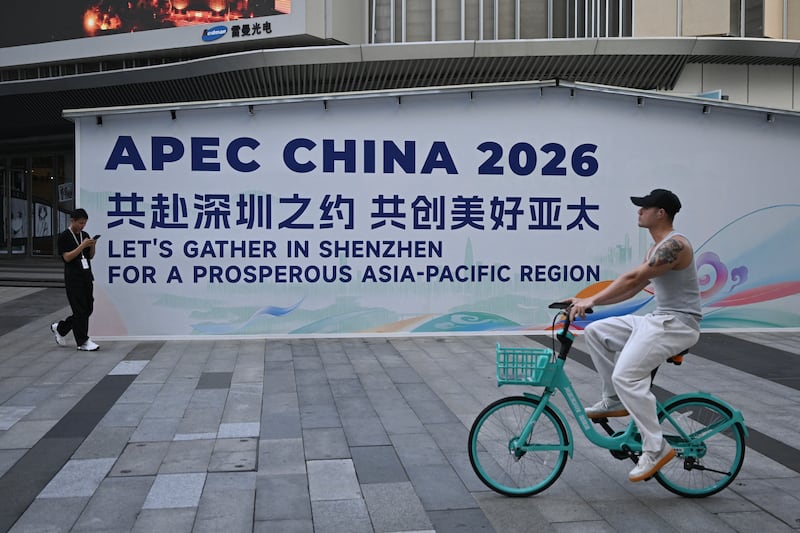
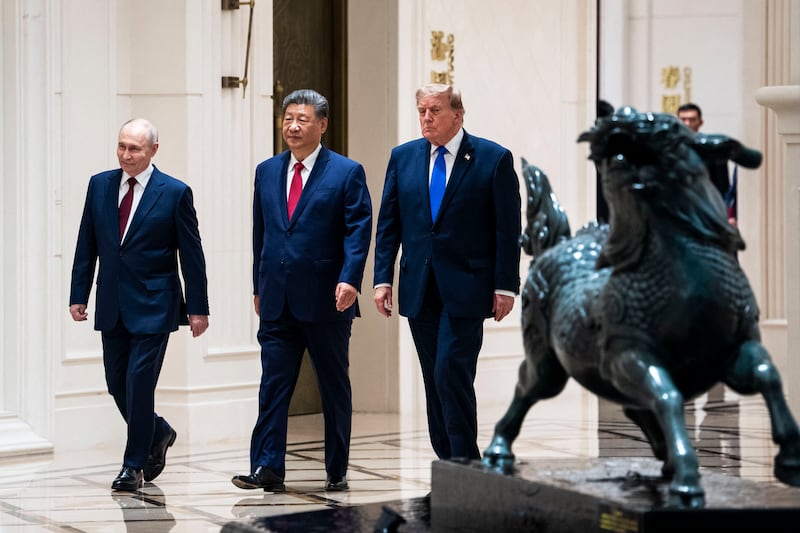
U.S. President Donald Trump met Chinese President Xi Jinping and Russian President Vladimir Putin for more than an hour on the sidelines of the Asia-Pacific Economic Cooperation (APEC) forum, describing the gathering as a historic diplomatic occasion.
Nuclear arms control and regional conflicts were high on the agenda amid deepening geopolitical and technological competition among the world’s major powers.
“As the world’s three largest nuclear powers by far, the United States, Russia and China are uniquely positioned to discuss how to reduce the number of nuclear weapons on Earth and also to lessen the risk that those weapons will ever be used,” Trump said in his opening remarks.
Although the meeting may have been historic, the three leaders have national interests that do not quite align on the nuclear question, David Fedor, a Stephenson Policy Fellow at Stanford University’s Hoover Institution, told RFA.
“Other than President Trump’s comments before the meetings about nuclear weapons, ... there was little signaling ahead of time that substantive decisions would be made,” said Fedor.
Xi called for the prohibition and destruction of nuclear weapons and the establishment of a world free of them, according to Chinese state broadcaster CCTV.
The summit marked the first leader-level talks on nuclear arms control since New START expired in February. Its lapse ended the last remaining bilateral nuclear treaty between Washington and Moscow, raising concerns about an unrestricted arms race.
Trump has called for a new agreement that would bring Beijing into nuclear arms control negotiations. China, however, has long maintained that Washington and Moscow should substantially reduce their stockpiles before asking it to accept limitations on its comparatively smaller arsenal.
China is estimated to possess more than 600 nuclear warheads, while the United States and Russia hold more than 5,000 each.
“Once you have the nuclear weapons, it’s very hard not to have them,” Trump said. “So it’s not an easy thing to do, give them up.”
Xi also proposed regular high-level exchanges and the creation of a crisis communication mechanism among the three powers to help manage tensions.
No concrete agreement on nuclear arms control was immediately announced following the summit.
The White House released a statement that said the three leaders “reaffirmed that a nuclear war cannot be won and must never be fought.”
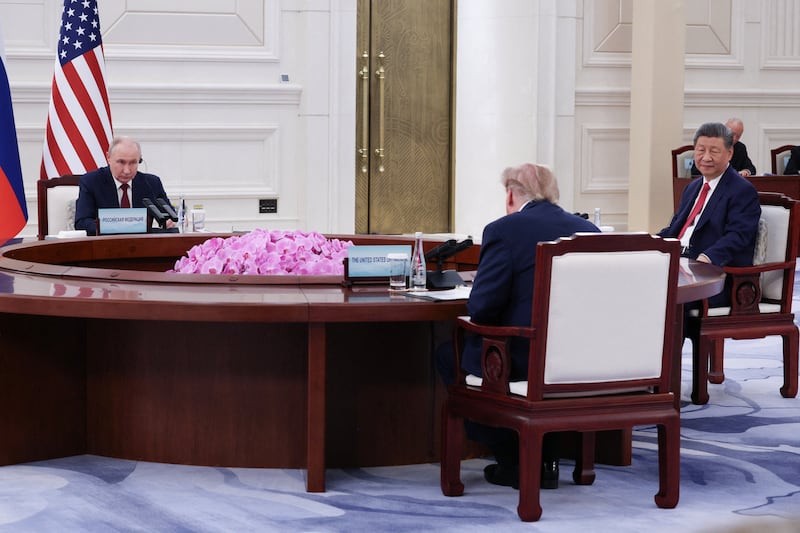
The statement also said that the three countries would hold dialogues on preventing the spread of nuclear weapons and minimizing nuclear risks.
Taiwan’s security concerns
Ahead of Thursday’s trilateral meeting, Taiwan’s government downplayed expectations that the island would feature prominently in discussions among the three leaders.
“From what we know, Taiwan is not the focus,” Mainland Affairs Council (MAC) spokesperson Liang Wen-chieh told a news briefing in Taipei.
Liang said the discussions were more likely to prioritize securing a ceasefire in Ukraine and addressing Iran’s nuclear program.
“Even if Taiwan is mentioned, it will be a relatively peripheral issue,” he said.
Liang also expressed doubts about whether the three leaders could reach substantive agreements given their competing interests and the limited time available for negotiations.
“The three parties want different things, and their priorities are also different,” he said.
Taiwan nevertheless featured in a separate bilateral meeting between Trump and Xi earlier on Thursday, their third face-to-face meeting this year.
Xi told Trump that Washington should “stick to doing the right thing” on Taiwan to avoid major setbacks in relations between the two countries, China’s official Xinhua News Agency reported.
According to Xinhua, Trump told Xi that the United States “does not support Taiwan independence.”
The White House had not released its own account of the bilateral meeting at the time of Xinhua’s report.
These statements, and others on Ukraine, seemed to be a repeat of previous statements, Ian Chong, an associate professor of political science at the National University of Singapore, told RFA.
" This whole series of meetings have been big on optics and small on deliverables," said Chong. “There were general declaratory statements but little visible substantive progress, at least on to the public. ... I suppose repeating the basic principles are better than nothing."
During the trilateral summit, Xi also called on major powers to respect each other’s sovereignty, territorial integrity and core interests, warning against crossing red lines on sensitive issues.
Taiwan, which joined APEC in 1991 under the name Chinese Taipei, is represented at this year’s summit by Acer founder and honorary chairman Stan Shih, appointed by President Lai Ching-te to attend on his behalf.
The lack of substance in statements regarding Taiwan was likely an outcome Taipei was hoping for, William Yang, senior analyst for North East Asia at the Belgium-based International Crisis Group.
“On Taiwan, an issue where there is very little basis for bilateral consensus, they basically treated it as a formality — something they had to mention briefly as part of the routine agenda, and then move on,” said Yang. “I think, overall, when the two sides’ readouts came out yesterday, the immediate reaction from the Taiwan government was probably one of relief.”
Neither Xi’s nor Trump’s statement did much to change the status quo for Taiwan, he said.
“Basically, Taiwan made it through another Trump-Xi meeting without any rhetoric being put forward that would cause major harm to Taiwan.”
Competition over artificial intelligence
The summit took place against a backdrop of mounting technological rivalry between Washington and Beijing, particularly over artificial intelligence (AI) and access to advanced semiconductors.
Trump has held off on imposing tougher restrictions on China’s access to advanced chips used to develop AI models, indicating that additional measures could aggravate bilateral tensions.
Xi urged Washington and Moscow to work with Beijing to maintain stable global supply chains and called on the three powers to “abandon Cold War mentality, not pursue decoupling and breaking chains.”
Competition over emerging technologies has become a major point of friction between the world’s two largest economies, alongside disagreements over trade and access to strategically important raw materials.
U.S. officials have accused Beijing of failing to fully implement commitments made during a Trump-Xi meeting last year, including pledges to purchase more American agricultural products and ease export restrictions on rare earth minerals used in electronics manufacturing.
A trade truce reached last year following successive tariff increases is due to expire on Jan. 10, 2027, adding another source of uncertainty to bilateral relations.
The meeting between Xi and Trump did little to ease this uncertainty, Riley Walters, deputy director of the Japan Chair at the Washington-based Hudson Institute, told RFA.
“It sounds like Trump and U.S. officials are still waiting on China to buy more soybeans and export more rocks, meaning maybe no progress is being made since their last meeting,” said Riley.
“Instead, it sounds like Trump and Xi simply meeting and talking has become the baseline for this relationship, and so long as they continue meeting then it’s construction.”
Fedor said that Trump seems to feel a sense of responsibility in managing relationships with Xi and Putin.
That sentiment is what drives him to ”stage these very public interactions with leaders like Chairman Xi and President Putin," he said.
“But I do not think those visits substantively change the underlying interests of the relevant parties, at least some of which are fundamentally contradictory.”
Edited by Eugene Whong.
Update adds comments from experts.